

Ada Lovelace
The Mathematical Genius Who Saw Beyond Numbers

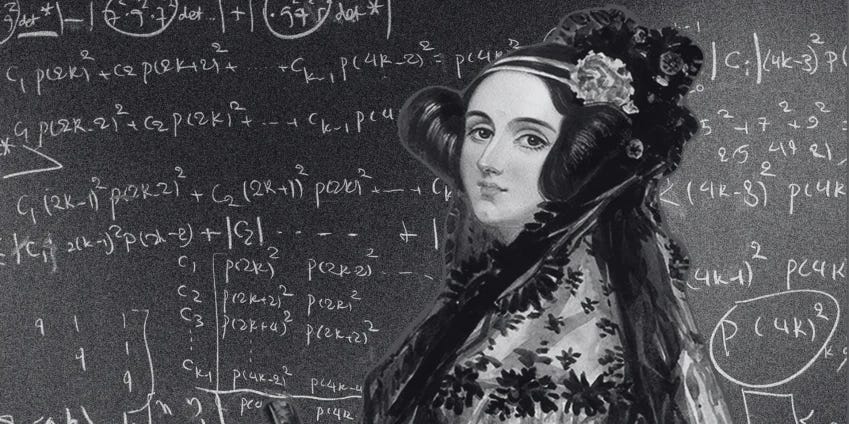
The year was 1843. While the world was still lit by gas lamps and messages traveled by horseback, a young woman sat at her writing desk in London, penning notes that would lay the foundation for the entire digital age.
She wasn’t just translating a technical paper about a machine that didn’t exist. She was seeing something no one else could see—that these calculating engines could do more than just crunch numbers. They could create music, art, and transform human thought itself.
This woman was Ada Lovelace, and without her revolutionary vision, you wouldn’t be reading these words on a screen today.
The Daughter Nobody Wanted
Augusta Ada Byron entered the world on December 10, 1815, to parents who couldn’t have been more different. Her father, Lord Byron, was England’s most scandalous poet – famous for his romantic affairs, revolutionary politics, and rumors of incest. Her mother, Lady Anne Isabella Byron, was a mathematical prodigy who believed logic could cure any moral failing.
Byron had wanted a son. When told he had a daughter, he wrote with disappointment about the “glorious boy” that never materialized. This rejection would define Ada’s entire childhood, though she wouldn’t learn the full extent of it until years later.
Lady Byron left her husband when Ada was five weeks old, taking the baby to her parents’ estate. Byron signed the separation papers reluctantly and left England forever. He died in Greece when Ada was eight, fighting for Greek independence. Ada never saw him again.
The separation turned out to be more than just a family tragedy—it was a public scandal that made Ada infamous before she could even walk. In Regency England, divorced women were social pariahs, and their children carried the stigma. Lady Byron knew she had to present herself as the perfect mother to maintain any social standing.
But perfect mothers in 1815 weren’t supposed to be mathematically gifted intellectuals. Lady Byron’s approach to raising Ada reflected her belief that mathematics and logic could prevent moral corruption. If Byron’s “madness” was hereditary, perhaps rigorous intellectual discipline could override it.
This created a strange childhood for Ada. She received an education that would have been exceptional for a boy, but it came with constant surveillance. Lady Byron hired friends to watch Ada for any signs of “moral deviation.” Ada called these watchers “the Furies” and later complained they invented stories about her behavior.
